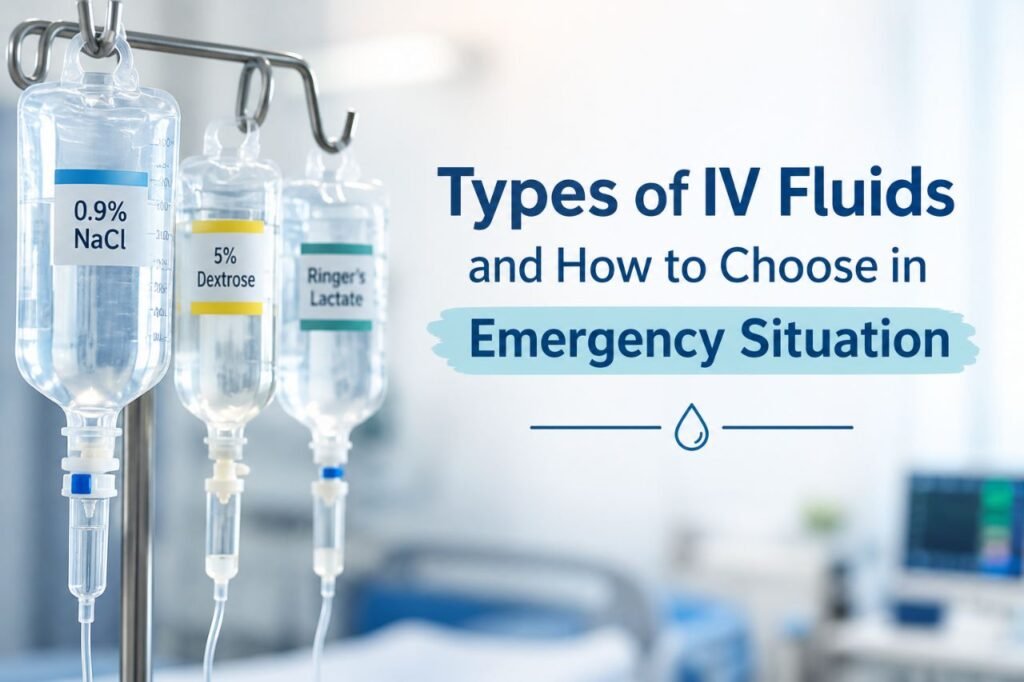
Introduction :-
What are intravenous fluids?
Intravenous (IV)fluids are sterile solutions that are administered directly into a vein through an IV catheter.
Indications of IV fluids :-
1- fluid resuscitation
2- maintenance fluid therapy
3- correction of electrolytes imbalance
4- delivery of IV medications.
1- fluid resuscitation :-
Involves administering IV fluids to rapidly restore circulating blood volume in cases of shock, severe dehydration or acute blood loss.
Amount and type of IV Fluid is determined according to the case and clinical response.
N.B: if the patient is hemodynamically stable, fluids should be administered less aggressively to avoid risk of fluids overload.
2,3: IV fluids as Maintenance fluids therapy and electrolytes imbalance correction :-
IV fluids are used to provide daily fluids and electrolyte requirements after patient stabilization. Very effective way especially when the oral intake is not possible or the individual cannot meet his/her daily requirements on its own.
Also, it plays a critical role in case of ongoing fluid loss ( such as in Burns and GIT losses). It depends on calculating the amount of lost fluid and using a mimic fluid composition.
Remember to subtract other sources of fluid intake ( e.g: blood transfusion, enteral nutrition) from the daily fluid volume to avoid fluid creep which is gradual unnoticeable accumulation of fluid in the body.
4- Delivery of IV medications :-
IV fluids are used as a vehicle to deliver the medication intravenously, commonly used fluids include Dextrose and Normal saline.
How do intravenous fluids work?
Intravenous fluids work by causing water to shift across the body’s fluid compartments. Water makes up around 60% of our total body weight, roughly 42 liters in a 70 kg individual. Around 40% of this water is distributed in the intracellular compartment (i.e., within cells) and the remaining 20% in the extracellular compartment (i.e., outside of cells). Extracellular fluid can be further interstitial fluid, .a surrounding cells,
and plasma, which is the aqueous portion of blood.
Each compartment has a specific osmolarity determined by the concentration of ions and other solutes. Free water moves across compartments to maintain a steady state so that osmolarity remains the same. If one compartment has a few more solutes than the other, water will flow in that direction to lower the concentration until it reaches a new state of balance.
Once administered, IV fluids redistribute throughout the body causing the movement of water and ions from one compartment to another. Isotonic fluids have a similar osmolarity to plasma, so they do not cause significant shifts between compartments. Hypotonic fluids have a lower osmolarity than plasma, causing water to cells, hypertonic fluids have a higher osmilarity than plasma resulting. in the movement of water out of the cell.
Types of IV Fluids:-
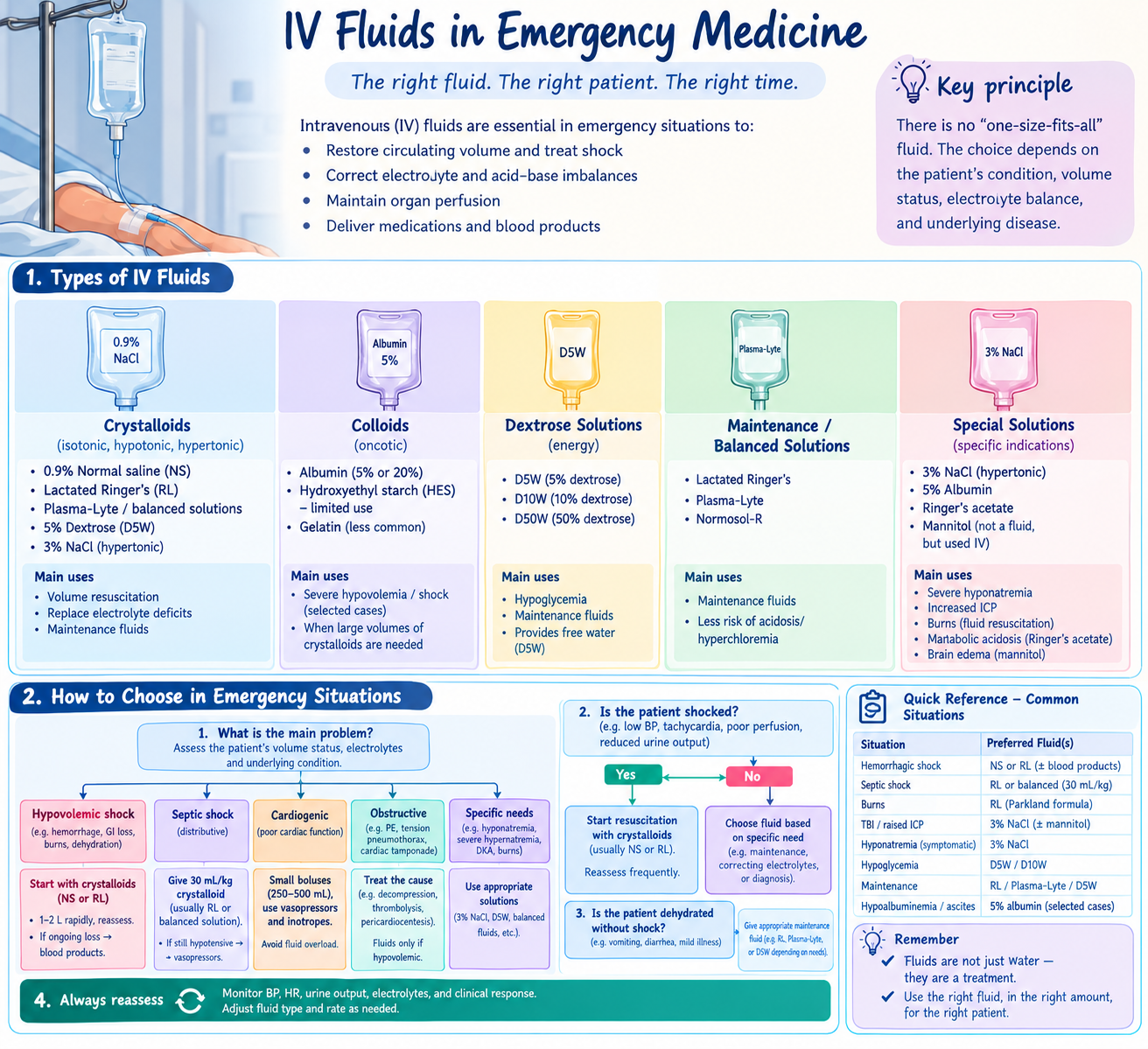
It has two major groups : crystalloids and colloids.
Crystalloids:-
Crystalloids are the most commonly used IV fluid in hospital settings.
They are made of small molecules, which enable them to have an easily movement across the cell membranes and quicker distribution between blood and tissue.
They are classified into 3 categories : hypotonic, isotonic and hypertonic fluids. This classification depends on its various concentration and composition.
Hypotonic fluids :-
They are mainly used to correct free water deficits ( have more water and less solutes).
Include : half normal saline and Dextrose (D5W is Hypotonic solution because body metabolizes glucose leaving free water).
Precautions : Hypotonic solutions are no longer used as a maintenance fluid, it can lead to hyponatremia and brain edema.
Isotonic solutions:-
Such as Normal saline and Ringer’s Lactate, they are commonly used in fluid resuscitation and maintenance therapy.
Hypertonic solutions :-
Hypertonic solutions such as 3% saline and 5% saline. They are very effective in cerebral edema reduction and hyponatremia correction.
Colloids ( plasma expanders) :-
They include : Albumin, starch, dextran and gelatin.
In adverse to crystalloids they contain large molecules that stays in the intravascular space. They are much faster in their effect than crystalloids but they are much expensive and carry-on risk of allergic reactions. It is used for treatment of hypoalbuminemia.
IV fluids and how to choose in emergency situations:-
1- septic shock :-
The recent guideline conducted by Society of Critical Care Medicine at 2026 surviving sepsis campaign states that in Adult patients with sepsis, balanced crystalloids ( such as Ringer’s Lactate) is favored over 9% normal saline, because of their electrolyte composition and clinical evidence.
Why is this?
Because Ringer’s Lactate composition is much closer to the plasma, so it produces less hyperchloremia and less metabolic acidosis than large-volume 0.9% saline.
While 9% Normal saline contains much higher chloride content that plasma, So in large volumes it will result in hyperchloremia which decreases the renal blood flow and lead to hyperchloremic metabolic acidosis.
The Amount of fluid given is 30ml/Kg in the first 3 hours followed by reassessment and individualized therapy.
2- Hemorrhagic shock :-
According to 2024 AAST/ACS Committee on Trauma Damage-Control Resuscitation protocol, the 2023 European trauma bleeding guideline
In major hemorrage the priority is to control bleeding and restore circulating blood components first. if blood products is not available, balanced crystalloids such as Ringer’s Lactate should be used. ( crystalloids replaces volume only, but does not replace the lost components).
N.B: the commonly used trauma approach is
RBCs : plasma : platelets = 1:1:1.
3- Major burns :-
The American Burn Association’s 2024 clicinal practical guideline addresses that adults with burns> 20% TBSA needs an IV fluids resuscitation starts initially by isotonic crystalloid ( Ringer’s Lactate) 2ml × body weight (Kgs) × TBSA%
Give 50% during the first 8 hours, and the remaining 50% during next 16 hours.
It also stimates that Albumin can be used as an adjunct specially when very large volumes of crystalloids are required.
With continuous monitoring.
4- Non hemorrhagic hypovolaemic shock :-
In non hemorrhagic hypovolaemic shock we replace the lost intravascular volume with isotonic crystalloids ( Ringer’s Lactate is favored over 9% saline in critically ill patients) with continuous reassessment and monitoring.
5- Traumatic brain injury :-
The 2024 ESICM guideline specifically suggests isotonic saline rather than balanced crystalloids in patients with traumatic brain injury.
( hypotonic fluids and large volume crystalloids are forbbiden, they can worsen the brain edema).
6- hypernatremia dehydration :-
In hypernatremia dehydration the aim is to replace free water deficit, this can be obtained routinely withp Dextrose or any other hypotonic fluid depending on the clinical situation.
7- hyponatremia :-
In reverse to hypernatremia here we use a hypertonic saline to correct the Na deficit.
8- hypoglycemia :-
hypoglycemia is primary corrected with glucose.
If the patient is conscious and able to swallow give it orally. If not conscious and cannot swallow give IV Dextrose.
N.B: isotonic crystalloids do not correct the underlying hypoglycemia.
9- DKA :-
Here The major part of treatment is IV Fluids to correct dehydration and electrolytes loss.
Initially we start by isotonic crystalloid ( Normal Saline) with continuous reassessment and monitoring.
We use insulin to Correct the hyperglycemia state, and give potassium to keep it in the normal range.
When the blood glucose fall behind 200_ 250 mg/dl, dextrose is added to the IV fluids so insulin can continue working.
10- Cardiogenic shock :-
It is the opposite of hypovolaemic shock, here we do not routinely give large volumes of IV Fluids it can worsen the cardiac status.
The treatment mainly depends on vasopressors and inotropes.
References :-
Intravenous (IV) Fluids: What Are They, Types, Indications, and More | Osmosis https://share.google/54vF1u2IulklsvpN4
https://www.sccm.org
American Burn Association Clinical Practice Guidelines on Burn Shock Resuscitation – PubMed https://share.google/7yYcGvLt7pnxCpkw6
✍️ كاتب المقال
🎓 الطب والجراحة — جامعة النيلين
📍 الحضور: أغسطس 2026 · القاهرة — السبت 12:45 ظهراً
⭐ قيّم هذا المقال
التقييم النهائي
★★★★★★★★★★
0.0/5
— 0 صوت
مقالات اخرى قد تعجبك