
Intravenous medication administration provides rapid
therapeutic effects but also creates a high risk of immediate harm when the
wrong medication, dose, route, concentration, or infusion technique is used.
This article examines the importance of selecting the correct administration
route and presents a four-category educational framework for IV medication
safety: (1) not licensed or contraindicated for IV use, (2) high-alert
medications, (3) restricted or protocol-dependent medications, and (4) medications
for which IV delivery is essential in selected indications. It explains why
certain medications must never be administered intravenously, why others
require specific safeguards, and when IV administration is necessary or
strongly preferred. The article also identifies important patient-related
risks, red flags requiring immediate action, and practical verification
measures that support safer IV medication administration. By combining route
selection, individualized patient assessment, careful preparation, monitoring,
and rapid intervention, healthcare professionals can reduce preventable
medication errors and improve patient safety
Introduction (ادوية ممنوع حقنها وريديا)
The correct dose or the correct drug does not ensure safe
treatment if the medication is administered through the wrong route. One of the
most dangerous medication errors is giving a medication intravenously when it
is designed only for intramuscular or subcutaneous administration; because the
drug enters the bloodstream directly, this mistake can cause severe toxicity,
cardiorespiratory arrest, or death within minutes.
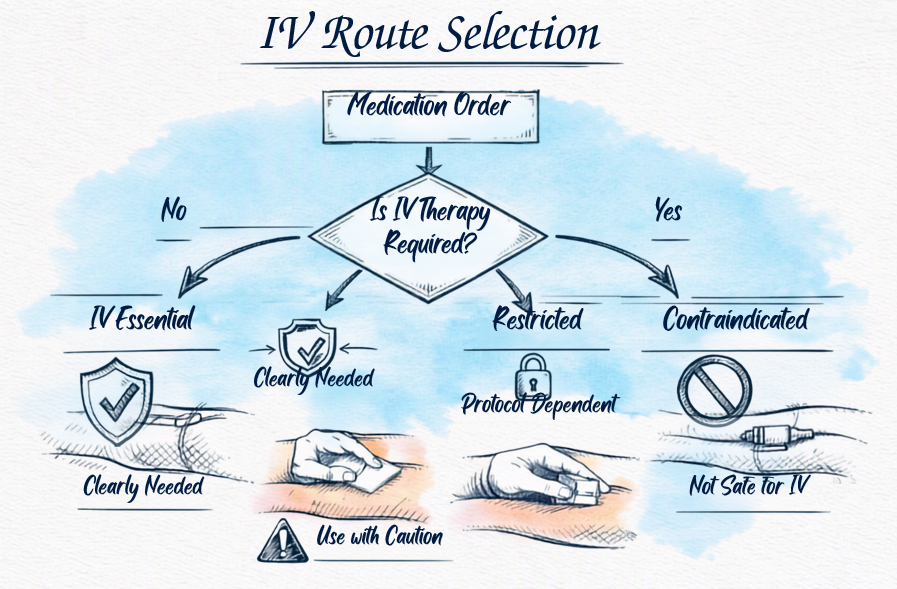
Choosing the correct route of administration is one of the
fundamental “rights” of medication administration. The right dose, right drug,
and right patient are not enough if the medication reaches the body through the
wrong route or is administered using the wrong technique. Unlike routes that
involve an absorption barrier, the intravenous route delivers medication
directly into systemic circulation, making adverse effects rapid and difficult
to reverse.
Scope and limitations ادوية ممنوع حقنها وريديا
This educational project does not replace the medication
order, official product information, local hospital policy, pharmacy guidance,
or supervision by a qualified healthcare professional. Dilution, concentration,
rate, line requirements, and monitoring may vary by product, patient age,
indication, and institution. The four categories used in this article are an
educational framework developed for this project; they do not replace the
medication’s official product information, local policy, or clinical judgment.
Why Use the IV Route? Advantages of IV Administration
Intravenous push (IV push) is the process of
introducing a medication or fluid substance directly into the bloodstream via
the venous system. When the medication is administered directly into the
bloodstream, it immediately enters the circulatory system and travels to a site
of action. Administering the medication directly into the bloodstream reduces
the first-pass effect, which is the metabolism that occurs when a medication
must be broken down by the liver before entering the systemic circulation.
- Rapid
onset of action
The intravenous route delivers medication directly into the
bloodstream. As a result, the body absorbs the drug completely and rapidly,
bypassing the digestive system and first-pass metabolism. This makes IV
administration essential during medical emergencies—such as cardiac arrest or
severe allergic reactions—where immediate treatment is needed to save a life.
- When
oral administration is impossible
Intravenous delivery provides a reliable alternative when a
patient cannot take medications by mouth. For example, patients who are
unconscious, vomiting constantly, or recovering from surgery often cannot
swallow safely. In these cases, the IV route allows medical staff to give
necessary treatments without the risk of choking or missed doses.
- Medications
unsuitable for other routes
Certain medications cannot be given safely through other
routes. Some drugs are completely destroyed by stomach acid if swallowed, while
others cause severe pain or muscle damage if given as a regular injection. By
delivering these medications directly into a vein, the flowing blood quickly
dilutes the drug, allowing it to work safely without harming surrounding
tissues.
- Fluid
and electrolyte therapy
The IV route is critical for managing fluids and
electrolytes in the body. When patients suffer from severe dehydration, severe
blood loss, or chemical imbalances, IV fluids can help restore blood pressure
and hydration. For patients who cannot eat for long periods, parenteral
nutrition may be administered intravenously when clinically indicated and
prescribed.
Types of IV Administration and Vascular Access ادوية ممنوع حقنها وريديا
Understanding the type of IV administration is essential for
safe practice.
- IV
push: medication administered directly into an IV access device over a
specified short period, according to protocol. - Intermittent
infusion: medication diluted in a compatible fluid and administered
over a defined period. - Continuous
infusion: medication administered continuously, usually using an
infusion pump. - Peripheral
IV versus central venous access: the required access depends on the
medication’s irritancy, concentration, osmolarity, vesicant properties,
and institutional policy. Some medications must be given through a central
line; others may be given peripherally with appropriate precautions.
Compatibility considerations include drug–diluent
compatibility, drug–drug compatibility, Y-site compatibility, line flushing
according to policy, and the use of dedicated lines for selected infusions.
Educational Safety Framework for IV Medications
ادوية ممنوع حقنها وريديا
Institute for Safe Medication Practices. (2024). ISMP list of high-alert medications in acute care settings. https://www.ismp.org/resources/highalertmedications
Panagioti, M., Hodkinson, A., Planner, C., Dhingra, N., & Gupta, N. (2023). Global burden of preventable medication-related harm in health care: A systematic review. World Health Organization. https://www.who.int/publications/i/item/9789240088887
Rajakumar, S., Rajah, R., Thanimalai, S., Mohd Mokhtar, F., & Ramachandram, D. S. (2025). Intravenous medication administration errors in hospitalised patients: An updated systematic review. Journal of Evaluation in Clinical Practice, 31(4), e70167. https://doi.org/10.1111/jep.70167
Sutherland, A., Canobbio, M., Clarke, J., Scott, M., & Ashcroft, D. M. (2020). Incidence and prevalence of intravenous medication errors in the UK: A systematic review. European Journal of Hospital Pharmacy, 27(1), 3–8. https://doi.org/10.1136/ejhpharm-2018-001624
U.S. Food and Drug Administration. (2023). FDA requires updates to labeling for promethazine hydrochloride injection products [Drug Safety Communication]. https://www.fda.gov/drugs/drug-alerts-and-statements/fda-requires-updates-labeling-promethazine-hydrochloride-injection-products
U.S. Food and Drug Administration. (2011). Parenteral Dilantin (phenytoin sodium injection, USP) prescribing information. https://www.accessdata.fda.gov/drugsatfda_docs/label/2011/010151s036lbl.pdf
U.S. Food and Drug Administration. (2014). Parenteral Dilantin (phenytoin sodium injection, USP) prescribing information. https://www.accessdata.fda.gov/drugsatfda_docs/label/2014/008762s050,010151s038lbl.pdf
World Health Organization. (2024). Improving global medication safety: WHO publishes systematic review and policy brief on preventable medication-related harm. https://www.who.int/indonesia/news/detail/01-05-2024-improving-global-medication-safety–who-publishes-systematic-review-and-policy-brief
1. Not Licensed or Contraindicated for IV Use ادوية ممنوع حقنها وريديا
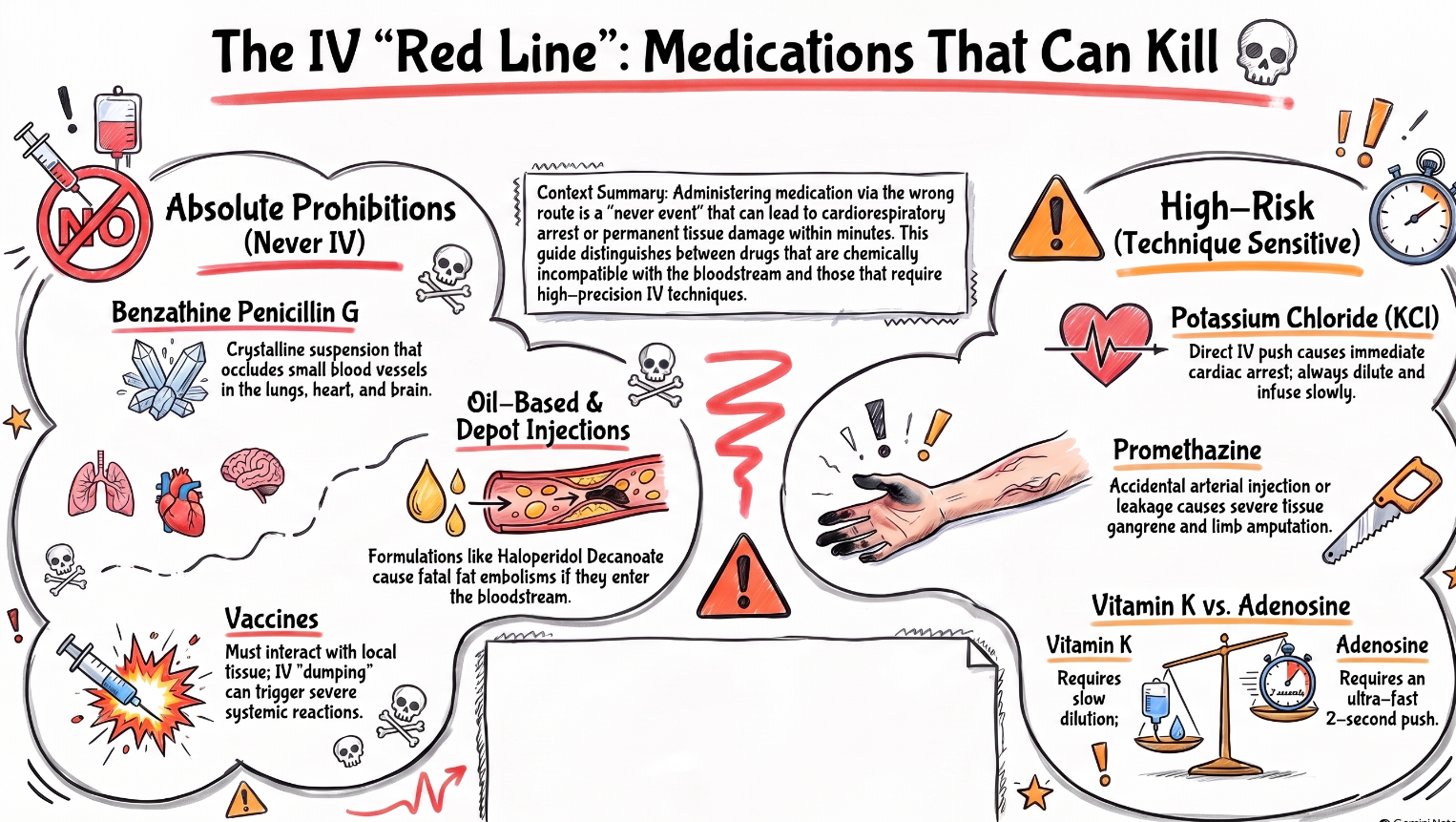
These medications should never be administered intravenously
because they are not formulated or approved for this route.
- Benzathine
penicillin G
Benzathine penicillin G is a poorly soluble depot suspension
intended for deep intramuscular injection only. Accidental intravenous or
intra-arterial administration can cause catastrophic cardiopulmonary and
neurovascular complications, including cardiac arrest and death. It must never
be administered intravenously.
- Oil-based
depot injections not licensed for IV administration
Some oil-based formulations are designed exclusively for
intramuscular or subcutaneous depot injection to allow slow, sustained
absorption. If such a formulation is injected into a vein, it may obstruct
small blood vessels and cause respiratory and cardiovascular complications.
These products must be administered only by the route specified in the product
information. Note that some lipid-containing preparations (for example, certain
parenteral nutrition products) are specifically designed for IV use; the route
depends on the specific formulation and product label.
- Vaccines
Vaccines must be administered only by the route specified in
the product information. Most injectable vaccines are given intramuscularly or
subcutaneously, depending on the product; intravenous administration is
generally not an approved route. Administering a vaccine by an unapproved route
can affect safety, effectiveness, and regulatory validity.
2. High-Alert Medications ادوية ممنوع حقنها وريديا
High-alert medications are drugs that carry a heightened
risk of causing significant patient harm when used in error. High-alert does
not mean the medication should not be used; it means extra safety precautions
are required. Because IV medicines go directly into the bloodstream, errors can
act very quickly, which is why extra safety steps are needed.
Examples include concentrated potassium chloride, insulin,
IV adrenergic agonists (such as epinephrine and norepinephrine), magnesium
sulfate, and others identified by organizations such as ISMP.ismp+1
- Concentrated
potassium chloride (KCl)
Concentrated potassium chloride must never be administered
by direct IV push. It must be diluted and administered as a controlled infusion
using an approved protocol and monitoring. Rapid administration can cause
severe hyperkalemia, life-threatening arrhythmias, and cardiac arrest. Safe
administration depends on the prescribed potassium dose, dilution and maximum
concentration, infusion rate, renal function and urine output, serum potassium
and ECG monitoring when clinically indicated, and use of an infusion pump
according to local policy.
- Promethazine
(Phenergan)
Promethazine is used to treat severe nausea, vomiting, and
motion sickness. Promethazine injection can cause serious tissue injury,
especially if inadvertent intra-arterial or subcutaneous administration occurs,
or if extravasation happens during IV administration. Current FDA communication
recommends deep intramuscular administration instead of IV administration when
possible, reflecting the serious tissue-injury risk associated with IV
promethazine.
If IV administration is specifically required, the current
product labeling and institutional protocol must be followed, including the
approved concentration, dilution, administration rate, venous access
requirements, and monitoring for extravasation. It must never be administered
intra-arterially or subcutaneously.
- Phenytoin
(Dilantin)
Phenytoin is used to treat active, life-threatening seizures
and to prevent seizures following severe brain injuries. Intravenous
administration of conventional phenytoin must not exceed 50 mg per minute in
adults and 1–3 mg/kg/min (or 50 mg per minute, whichever is slower) in
pediatric patients because of the risk of severe cardiovascular reactions.
Conventional phenytoin injection should be diluted only as
specified, commonly in 0.9% sodium chloride, and requires continuous cardiac
and blood-pressure monitoring during infusion. Rapid administration can cause
hypotension, arrhythmias, and cardiovascular collapse. Phenytoin can also cause
severe local tissue injury; a rare but serious complication known as “Purple
Glove Syndrome” has been associated with phenytoin extravasation or peripheral
administration. Fosphenytoin is a different medication with different
administration instructions and compatibility considerations.
- Insulin
Insulin is used in acute medical emergencies to treat
diabetic ketoacidosis (DKA), dangerously high blood sugar levels, and severe
hyperkalemia. In hospital protocols, IV insulin infusions generally use
short-acting regular human insulin. The prescription must specify the insulin
product and concentration, and IV insulin requires frequent blood-glucose
monitoring and a protocol for adjusting dextrose and potassium.
Administering insulin intravenously carries high risks
because it acts rapidly to promote cellular uptake of glucose and potassium. An
accidental overdose or rapid bolus can cause severe hypoglycemia, leading to
coma, seizures, or fatal arrhythmias from a sudden drop in blood potassium.
Because of these risks, only appropriate insulin formulations should be used
intravenously, and only under a defined protocol.
3. Restricted or Protocol-Dependent Medications ادوية ممنوع حقنها وريديا
The restricted category includes drugs that can be given IV,
but only under specific conditions such as correct dilution, controlled
infusion rate, and the right IV access. This category is used for medicines
that can cause harm if pushed too fast, given undiluted, or given through the
wrong line.
| How to give it IV safely | preferred route | when it is used | Drug |
|---|---|---|---|
| IV administration is not absolutely contraindicated but carries a risk of severe hypersensitivity or anaphylactoid reactions. It should be reserved for situations in which the benefit outweighs the risk, administered slowly as a diluted infusion (no direct IV push), with appropriate monitoring, according to the product information and institutional protocol. In patients with serious bleeding or anticoagulation, IM injection may be inappropriate because of hematoma risk; the route depends on the clinical situation. | Oral or IM when appropriate | To treat or prevent bleeding resulting from vitamin K deficiency | Vitamin K1(Phytonadione) |
| Infuse with a pump as a controlled continuous drip. Central access is preferred; if peripheral access is used, it should be a large-bore line in a large vein and closely monitored for extravasation | Continuous IV infusion, preferably through a central venous catheter | Used for serious Gram-positive infections, including MRSA | Norepinephrine |
| Dilute properly and infuse slowly, usually over at least 60 minutes; larger doses may need longer. Rapid infusion increases the risk of vancomycin infusion reaction, hypotension, and flushing. | IV infusion when oral therapy is not appropriate for systemic infection | Used for serious Gram-positive infections, including MRSA |
Vancomycin |
| Must be well diluted and infused at a limited rate with monitoring of phosphate, potassium, calcium, and renal function to avoid arrhythmias, hypocalcemia, and tissue injury | Oral replacement if the patient can take it; IV if severe or urgent | Used to treat or prevent hypophosphatemia, especially in critically ill patients or when oral replacement is not possible | Potassium phosphate |
| Give slowly, preferably through a central line if possible, because calcium chloride is irritating to veins and can cause tissue necrosis if extravasation occurs |
IV only when rapid correction is needed; calcium gluconate is often preferred for peripheral use |
Used for severe hypocalcemia, hyperkalemia with ECG changes, or calcium-channel blocker toxicity |
Calcium chloride |
4. Medications for Which IV Delivery Is Essential in
Selected Indications ادوية ممنوع حقنها وريديا
- Adenosine
Adenosine belongs in the IV-essential category because
intravenous administration is the only route capable of delivering the drug to
its site of action before it degrades. Its plasma half-life is less than 10
seconds, meaning it is broken down almost instantaneously in the bloodstream.
Adenosine is used for selected regular narrow-complex
supraventricular tachycardias, not every fast rhythm. It should be administered
rapidly through a suitable IV access followed immediately by a flush, according
to the local protocol. Continuous ECG monitoring and resuscitation equipment
should be available. It may be ineffective in some rhythms and requires
clinical assessment before administration. Adenosine causes a transient
AV-nodal conduction block and may produce a brief period of asystole; monitoring
the heart rate is essential.
- Epinephrine
Epinephrine is used during cardiac arrest, severe
anaphylaxis, and life-threatening shock. The route and concentration depend on
the indication:
- Anaphylaxis:
usually IM epinephrine in the lateral thigh according to protocol. - Cardiac
arrest: IV or intraosseous epinephrine according to resuscitation
guidelines. IV access is attempted first when practical; intraosseous
access is an alternative when IV access cannot be rapidly obtained. - Shock
or severe hypotension: controlled infusion, usually with a pump and
close monitoring.
Concentration errors are a major hazard. Always verify the
concentration and indication before administration.
- Magnesium
sulfate
Magnesium sulfate is used in torsades de pointes (a
dangerous, specific type of fast, irregular heart rhythm) and selected cases of
severe asthma. In emergencies, magnesium must act quickly. IV administration
produces a rapid increase in serum magnesium. It must be diluted and given at a
controlled rate, with monitoring of respiratory rate, blood pressure, and deep
tendon reflexes. Excess magnesium can cause muscle weakness, respiratory
depression, and cardiac arrest.
Patient-Specific Risk Assessment
The safety of IV medication administration also depends on
the patient’s underlying health conditions. Before selecting the IV route,
catheter type, and infusion plan, healthcare professionals should consider the
patient’s medical history, vascular condition, comorbidities, and ability to
tolerate the prescribed medication or fluid. Some diseases make IV
administration harder and more dangerous, requiring more careful monitoring.
- Severe
heart failure or pulmonary edema
Patients may not tolerate rapid IV fluids. Monitoring oxygen
saturation, respiratory rate, blood pressure, lung sounds when appropriate, and
urine output is essential. Excessive or inappropriate fluids can worsen
pulmonary edema and heart failure.
- Advanced
chronic kidney disease or renal failure
Reduced kidney function can delay the elimination of
medications and fluids, increasing the risk of drug accumulation. Monitoring
urine output, renal function, and relevant drug levels is essential.
- Cancer
Patients may have fragile veins, an increased risk of
infection, and some drugs may cause serious tissue damage if they leak outside
the vein.
- Diabetes
mellitus
Diabetes is associated with weak circulation, delayed
healing, and reduced sensation, so patients may not feel early pain from
infiltration. Inspect the IV site frequently rather than relying only on
patient-reported symptoms.
- Severe
dehydration or shock
This can make the veins less visible, increasing the risk of
multiple attempts; ultrasound-guided access may be required.
Red Flags for IV Administration ادوية ممنوع حقنها وريديا
Red flags during IV medication administration are warning
signs of a possible medication error, infusion reaction, or IV-site
complication that may cause serious harm if treatment continues. When any red
flag appears, stop the infusion immediately, assess the patient and the IV
site, and verify the medication and administration details before taking
further action.
- New
pain, burning, or stinging at the IV site
Stop the infusion, inspect and palpate the site (check the
area visually for redness, swelling, or leaking and gently touch around the
insertion area using your fingertips to feel for localized warmth, hardness,
pain, or fluid buildup). Do not attempt to flush the catheter or restart the
infusion through the same line. Flushing or restarting forces medication or
fluid directly into surrounding subcutaneous tissue rather than the vein lumen.
If the drug is an irritant or vesicant, this drastically increases the risk of
severe nerve and tissue damage.
- Swelling,
coolness, or color change
Stop the infusion and disconnect the tubing. Assess
circulation and the extent of swelling. If infiltration is confirmed, remove
the catheter, elevate the limb, and restart at a different site if treatment is
still required.
- Blisters,
skin breakdown, severe redness, or tissue darkening
Treat this as possible extravasation. Stop the infusion,
leave the catheter in place, aspirate residual medication if trained and
authorized, and do not flush. Notify the prescriber and pharmacist urgently;
apply the drug-specific compress or antidote protocol.
- Redness,
warmth, or hard vein
Stop the infusion and remove the peripheral catheter if
phlebitis is suspected. Inspect the site, document the findings, notify the
clinician if symptoms are significant, and insert a new IV at another site if
necessary.
- Fluids
leaking from the catheter or dressing
Stop the infusion and clamp or disconnect the line. Check
whether the catheter has migrated or the connection is loose. Do not continue
through the site until it has been assessed.
- Resistance,
occlusion alarms, loss of free flow, or an unexplained rate change
Stop the infusion. Check for closed clamps, kinks, an empty
bag, a closed stopcock, or a positional catheter. Never force a flush or
medication through a resistant line. If patency cannot be confirmed, replace
the access device.
- Hives,
facial swelling, wheezing, or difficulty breathing
Stop the medication immediately but maintain IV access with
compatible fluid if appropriate. Assess airway, breathing, circulation, oxygen
saturation, and blood pressure. For suspected anaphylaxis, call for emergency
assistance and administer IM epinephrine according to the emergency protocol.
Do not delay treatment while waiting for an ECG or laboratory result.
- Chest
pain, falling oxygen saturation, or shortness of breath
Stop the infusion immediately and instantly evaluate airway
and breathing, and administer supplemental oxygen according to standard
protocol. Then check vital signs and run an ECG. This critical data allows the
team to determine whether the reaction is caused by acute drug toxicity, severe
allergic response, fluid overload in the lungs, or heart failure, so targeted
treatment can begin without delay.
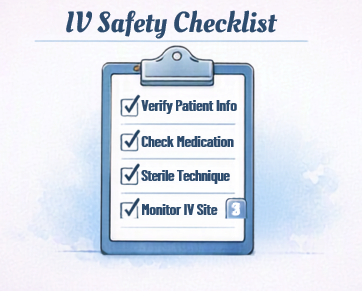
Safety Checklist for IV Medication Administration ادوية ممنوع حقنها وريديا
Before preparation
- Prepare
medications in a designated clean area away from sinks and other sources
of contamination. - Perform
hand hygiene and use aseptic technique. - Check
the medication order, two patient identifiers, allergies, medication name,
dose, concentration, route, rate, and expiry date. - Use a
new sterile needle and syringe for each patient and each entry into a
medication container. - Disinfect
the vial diaphragm before piercing it. - Use
single-dose vials, ampoules, IV bags, and bottles for one patient only. - Do not
combine leftover medication from single-dose containers for later use. - Consider
weight-based dosing where relevant. - Review
renal and hepatic function and current laboratory values when appropriate. - Confirm
indication and expected effect. - Arrange
independent double-check for selected high-alert medications. - Use
barcode medication administration where available. - Use
smart-pump drug libraries where available. - Perform
verbal read-back for unclear or unusual orders.
During administration
- Use
the correct medication and administration set for the intended patient. - Use IV
tubing, connectors, and infusion equipment for one patient only. - Confirm
the prescribed dilution, infusion rate, and compatibility before
administration. - Ensure
that the syringe and tubing are free from air. - Monitor
the patient and IV site during administration. - Stop
the infusion if pain, swelling, leakage, redness, breathing difficulty,
rash, altered consciousness, or sudden clinical deterioration occurs. - For
suspected extravasation, stop the infusion, do not flush, and follow the
medication-specific protocol.
After administration
- Dispose
of needles, syringes, vials, and administration equipment safely. - Do not
reuse syringes, even if the needle is changed. - Document
the medication, dose, route, rate, patient response, and any adverse
event. - Report
medication errors, near misses, infections, and infusion complications
according to institutional policy. Incident reporting helps identify
system problems and is not only about individual blame.
Conclusion
Intravenous medication administration is one of the fastest
and most effective ways to deliver treatment, but it also carries a high risk
of immediate harm. The correct drug and dose cannot compensate for an incorrect
route, concentration, dilution, infusion rate, or administration technique.
Therefore, every IV medication must be assessed according to its safety
requirements and classified as not licensed or contraindicated for IV use,
high-alert, restricted or protocol-dependent, or essential for IV delivery in
selected indications.
Safe IV practice depends on individualized patient
assessment, accurate medication verification, appropriate vascular access,
aseptic preparation, compatibility checks, controlled administration, and
continuous monitoring. Recognizing red flags early and stopping the infusion
promptly can prevent complications from becoming life-threatening. Ultimately,
IV medication safety is not simply about giving a medication through a vein; it
is about selecting the correct route, using the correct safeguards, and responding
immediately when something is not right. This systematic approach helps reduce
preventable medication errors and supports safer, higher-quality patient care.
